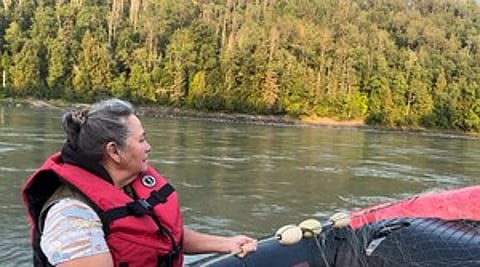


VANCOUVER — The BC Supreme Court has issued another decision stalling a massive project in Canada’s westernmost province, finding the government failed in its “duty to consult” a First Nation so small it is not even recognized as a band by the federal government.
The Kerr-Sulphurets-Mitchell project — better known as the “KSM Project” in northwestern British Columbia — is a proposed open pit and underground gold, copper, silver and molybdenum mine located in the asserted traditional territory of a number of First Nations.
As BC Supreme Court Justice Emily Burke noted in her June 8 decision: “It is said to be the world’s largest undeveloped gold project."
One of the groups whose territory overlaps with the project is the Tsetsaut Skii km Lax Ha Nation, led by Hereditary Chief Darlene Simpson.
In the petition that reached Justice Burke, Chief Simpson argued on behalf of the "nation" that the province failed to properly assess the strength of the "nation’s" Section 35 aboriginal rights and title claim before issuing the substantial start determination.
A “substantial start determination” is a critical regulatory step under the province’s Environmental Assessment Act. In plain English, it means a company has sunk enough money and research into a project that it is essentially ready to proceed, If the determination is granted, the certificate becomes valid for the life of the project.
Money and research had in fact been sunk into the project — a lot of money and research, in fact.
Seabridge Gold said it has invested more than $1.2 billion into the KSM project already.
The project sits about 65 kilometres northwest of Stewart in the Golden Triangle region of northwest British Columbia.
The Tsetsaut Skii km Lax Ha Nation had argued that significant parts of the project area, including the Treaty Creek Valley, lie within its "traditional territory."
The court agreed, stating the province fell short of its constitutional "duty to consult" the "nation" at proper depth.
The federal government, however, does not recognize the Tsetsaut Skii km Lax Ha Nation as a band under the Indian Act.
Recognition as a band under the Act generally requires a formal request to Indigenous Services Canada or Crown-Indigenous Relations and Northern Affairs Canada, followed by an assessment that the group constitutes a distinct indigenous community with shared identity, culture, language, and historical continuity.
The Tsetsaut Skii km Lax Ha Nation does not publicly disclose traditional government financial statements or operating budgets.
This also means there is no official federal registry or tracking of the number of members in the “nation.”
The recent June 8 BC Supreme Court decision that required KSM to go back to the drawing board as it waits for the province to meet its full "duty to consult" described the nation as having “58 known members.”
However, a 2017 environmental assessment report related to a different mining project referenced, however, a self-estimate by Chief Simpson of only 35 members.
The BC government has listed the number of members even lower, at approximately 30.
The Tsetsaut Skii km Lax Ha Nation, through Chief Simpson, refers to itself as the “matrilineal descendants of the original Tsetsaut people.”
A 2009 genealogy chart prepared by Rescan for the British Columbia Transmission Corporation shows the claimed matrilineal line of the Skii km Lax Ha name bearers in red.
The diagram is colour-coded and formally presented, yet it begins with several boxes labelled simply “Unknown.”
Further down the tree, multiple individuals are identified only by first name or as “Kathy Unknown.”
The chart was submitted as part of a regulatory filing, but its foundational ancestors remain unidentified and several later entries lack basic identifying information.
To be clear: the “original Tsetsaut people” did exist.
In fact, they were so numerous early ethnographers were able to identify two distinct groups of Tsetsaut people: Western and Eastern, separated geographically by the Coast Mountains and differing somewhat in their seasonal movements and interactions with coastal Tsimshian-speaking peoples.
A 2021 ethnohistoric report by the BC Ministry of Attorney General — following a review process that began around 2016–2017 under then-Attorney General David Eby — stated that early ethnographic records put their combined numbers at well over 500.
These “records,” however, are often patchy, second-hand, and filtered through the eyes of explorers, hunters, and early settlers.
Population numbers like “more than 500” were usually rough trader estimates or stories heard from other First Nations, not headcounts.
In 1894, ethnographer Franz Boas wrote that the Western Tsetsaut had been reduced to a group of 12 men and their families.
By 1907, ethnographer George T. Emmons was able to find only 7 individuals identifying as Western Tsetsaut.
Subsequent ethnographic work in the region was unable to locate any individuals identifying as either Western or Eastern Tsetsaut after that time.
The modern Canadian Encyclopedia refers to the Tsetsaut peoples in past tense and as "extinct."
Yet in the 21st century, that historical near-disappearance has been reversed through the determined work of one woman.
Before 2005, the name "Skii km Lax Ha" was held by Johnny Wilson as part of a Gitxsan house group.
After Wilson passed the name to Simpson in 2005, she began asserting the Tsetsaut Skii km Lax Ha as a distinct nation with its own independent rights and title, rather than as a house within the Gitxsan Nation.
Since 2005, Chief Simpson holds the hereditary name "Skii km Lax Ha" and serves as chief of what she now calls the Tsetsaut Skii km Lax Ha Nation.
Court documents show she previously held the name Adii am before succeeding Johnny Wilson as the title holder before declaring herself as the “nation’s” hereditary chief in 2005.
Only three short years after declaring herself the hereditary chief in 2005, Darlene Simpson — now known as Chief Simpson, holder of the name Skii km Lax Ha — had already secured formal provincial recognition of the newly formed "nation" and its asserted territory.
In a June 2008 letter, the Ministry of Aboriginal Relations and Reconciliation confirmed it would incorporate her newly submitted boundary map into the province’s Consultative Area Database, the internal system used to guide which First Nations must be consulted on Crown land and resource decisions.
In Canada’s existing aboriginal laws legal framework, indigenous collectives do not need large populations, elected band councils, or Indian Act reserves to assert aboriginal rights and title.
A self-declared "hereditary chief," like Chief Simpson, can sketch any documented lineage, continuity, and connection to territory, can name themselves a hereditary chief, bring claims forward in court, and trigger the Crown’s “duty to consult” on projects that may affect those rights.
Simpson, who also runs a small equipment and excavation company with her husband, used that framework to become a major centrepiece to one of the world's largest undeveloped mining projects.
Almost singlehandedly, but also with the help of an Ottawa law firm and financing and training subsidized by the BC government over several decades, Chief Simpson began filing detailed land claims that were then added to the province's Consultive Area Database, thereby creating a legally binding "duty to consult."
And then there’s the issue of overlapping claims with larger neighbouring nations.
This Tahltan territory map highlights one of the most significant overlaps affecting the Tsetsaut Skii km Lax Ha Nation.
In contrast to the very small Tsetsaut Skii km Lax Ha Nation, the Tahltan Nation has approximately 4,000 members, is fully recognized as a First Nation under the Indian Act, and continues to provide transparent and audited financial statements in accordance with federal legislation.
In 2023, the province, following its own Updated Ethnohistoric Report, informed Chief Darlene Simpson that “all evidence suggests” the Treaty Creek Valley is part of Tsetsaut Ski kn Lax Ha territory.
This has created a direct conflict between the province’s existing recognition of Tahltan interests, as the overlapping claims sit in the exact area where the project’s most environmentally sensitive infrastructure is planned.
The Gitanyow Nation, which has around 800 members, and already contends with the issue of overlapping claims with other nearby or neighbouring nations, is arguing in court that the Tsetsaut Skii km Lax Ha Nation shouldn’t be allowed to claim its own rights and title in the same area.
This comes after Chief Simpson took on the hereditary name Skii km Lax Ha back in 2005.
Before that, the name had been part of a Gitxsan house group. Since then, she’s worked to have the Tsetsaut Skii km Lax Ha treated as its own distinct nation. On top of the pushback from Gitanyow, the federal government has also said it doesn’t recognize the Tsetsaut Skii km Lax Ha Nation as having Section 35 rights, and doesn’t have any formal relationship with it.
In summary: under Canada's constitutional framework, a self-declared “hereditary chief” with a documented family line that had largely—if not completely—faded from official records by the early 1900s is capable of transforming a small group of relatives into a legally active indigenous “nation” capable of forcing the British Columbia government back to the consultation table on one of the largest proposed gold mines in the world.
No matter how small, these mighty "nations," which aren't even recognized by the federal government as existing as bands, have power in the courts to stall major projects and override not only multiple levels of government, but also other, much larger, First Nations.
The Western Standard reached out to Chief Simpson and the Tsetsaut Ski kn Lax Ha "nation" with several questions related to our article but did not receive a response.
