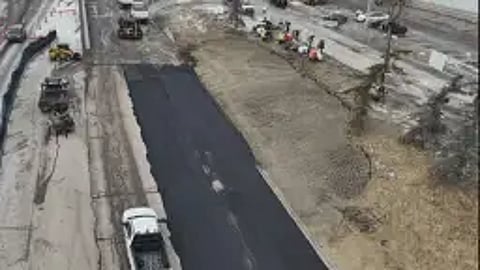


The Bearspaw south feeder main break repairs are close to completion, with expectations it will be brought back into service in as soon as two days, although there is still a risk of another break.
Sue Henry, chief of the Calgary Emergency Management Agency, said the city has a plan in place should another break occur.
“Over the past few days, we have removed parts of the two sections of the berm along Montgomery Boulevard northwest, installed temporary barriers along the Bow River pathway near Parkdale Boulevard between 30th and 33rd streets,” said Henry at a press conference on Monday.
“We have cleared catch basins, opened river outflows, and replaced select manhole covers with ones that allow water to drain more quickly.
Henry added residents in the area may see an increased presence of utility teams, city work crews, the Calgary Fire Department, Calgary police and peace officers.
“Additional measures like sandbags may be deployed proactively at certain locations as needed,” she said.
“I want to reassure people that seeing mitigation activities in their neighborhoods that this isn't about expecting another break, but it's about being prepared for one. We are not waiting and we are not taking chances.”
General Manager of Infrastructure Services for the City of Calgary, Michael Thompson, said, “Over the weekend, we continued refilling the feeder main with 22 million liters of water, the equivalent to approximately nine Olympic-sized swimming pools.”
"We are now collecting samples to test the water to make sure it is meeting or exceeding regulatory standards from Alberta Health Services and Alberta Environment in protected areas.”
Once testing procedures have been completed, stabilizing the system will begin.
"That includes turning on the pumps of the Bearspaw water treatment plant and starting to flow water through the pipe,’ said Thompson. “Once the pipe is returned to service, we will begin the process of easing out of water conservation. If everything goes well, we will return the pipe to service in the next few days,”
That won’t be the end of work on the feeder main.
"We will return in the spring and fall to do planned work to reinforce numerous sections of the pipe that are at most risk of a future break,” said Thompson.
“This will require stage four restrictions and indoor water conservation. We are waiting until the spring because that is when the snow melt starts and Elbow River flows into the Glenmore Reservoir are high enough that it can be refilled if we experience another break.”
“We will work closely with those in the area to make sure they are informed and to provide support should any contingencies be needed.”
Mayor Farkas acknowledged Calgarians for conserving water.
“We are almost through this and I want to start with a very simple thank you. Thank you to everyone who has made real efforts to cut back on water use over the past few weeks. We know that this has been frustrating, but it's because of your compliance and because of the around the clock work of crews and because city council has been fully focused on this every single day that we are making progress,” said Farkas.
“Now as we look ahead, we need to be very clear we are not out of the woods yet. As we refill this pipe and bring it back up to pressure, there's still a real chance that we could see another break. And that's why, Calgary, we still need you. Even if it feels like we're close, and we are, we need you to stay in conservation mode for just a little bit longer.”
“It helps protect things like fire response, hospital capacity and our ability to respond if something goes wrong. So, please keep showers short, hold off on laundry and dishes where you can. Only flush when necessary and avoid outdoor use.”
Farkas said the water main break has been a large learning experience.
“We learned that the safety measures we believed were in place before December 30th did not work the way we expected them to,” he said.
“We now know that this pipe can fail, and it's that new reality that has changed our approach and it's clarified three things. First, we need to move faster. Second, we need to detect risk sooner. And third, we need to operate at the pace Calgarians expect and deserve because moving forward, we are in uncharted territory.”
