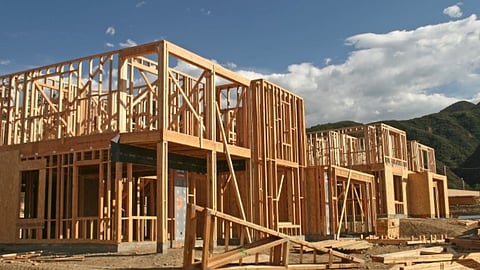


For the last two years, Calgary and area land developers and new home builders broke records for new home starts, beating all other major Canadian cities.
According to the Canada Mortgage and Housing Corporation (CMHC) new homes starts in 2024 were just under 21,000 and in 2025, just under 28,000, driven by record-breaking interprovincial immigration, primarily from Ontario and BC.
The increased construction activity has kept the City of Calgary’s building permits approval department busy, according to information supplied by the city on Thursday.
In 2024, 21,365 permits were issued, escalating to 27,952 permits in 2025, compared to the 10-year annual average of 13,199 permits.
According to the city, non-market (affordable) housing permits reached 1,836 in 2025, five times the annual average.
“These results are an indicator that the city’s programs and investments to increase the supply of non-market housing are enabling projects to move forward,” said Reid Hendry, chief housing officer at the city.
“While we still have lots of work to do to achieve our goal of 3,000 non-market homes per year, we’re starting to see what’s possible when all orders of government, the development industry and non-profit partners work together to deliver the homes Calgarians urgently need.”
Separately, secondary suites and downtown office conversions added to the supply of new homes in 2025.
There was a record of 6,185 permits issued for secondary suites, compared to just under 5,000 in 2024 and 3,000 in 2023, taking the total of registered suites in the city to 23,500.
Five downtown residential conversion projects opened in 2025, adding 490 homes, compared to 110 in 2024.
Growth in new and developing communities accounted for 57% of the new homes while existing communities accounted for 43%, with about 13,000 new homes being issued building permits in new communities and about 9,600 permits issued in developed areas in 2025.
By comparison, new communities comprised 73% of permits with developed areas accounting to 27% in 2024.
“This significant shift in growth split is due in part to our policies and incentives focused on developed area growth,” said Kathy Davies Murphy, director of city and regional planning.
“Calgary’s Municipal Development Plan has a long-range target of 50% of cumulative growth in developed areas and the 2025 percentages reflect both the market and the city’s efforts to achieve that.”
“As we plan our city for two million people and beyond, we are focused on creating complete communities provide choice for Calgarians to live close to jobs, services and transit.”
Hendry said the city acknowledges housing affordability challenges will take time to overcome, and collaboration with developers, non-profit housing providers, and other levels of government will be essential to maintain momentum and responding to changing housing needs and market conditions.
“While we continue to be Canada’s housing engine, we recognize that tens of thousands of Calgarians are still struggling with affordability and inadequate housing for their needs,” he said.
“In 2026 and beyond, we are committed to continuing to lean in and meet this challenge head on, so that every Calgarian has a safe, stable and affordable place to call home.”
"Another record year of creating more housing in Calgary proves that we can build at the speed and scale required to tackle the affordable housing crisis," said Mayor Jeromy Farkas.
"Together with the development industry, non-profit housing providers and all orders of government, we have the tools, skills, and will to build the homes all Calgarians need now and into the next decade."
