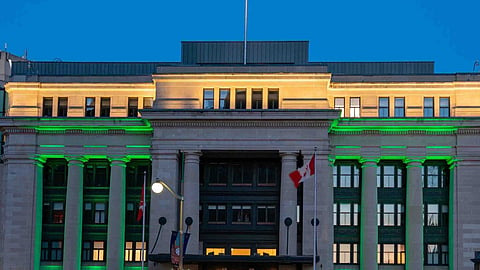


The next rate announcement from the Bank of Canada is Wednesday, with the general consensus from economists and financial institutions being it will hold its rate at 2.25%.
The war in the Middle East, causing oil prices to soar, will take any pressure off the bank to cut the rate, says Penelope Graham of Ratehub.ca.
“Once again, the Bank of Canada is facing fresh geopolitical upheaval while it makes its monetary policy decision,” says Graham.
“With the onset of the war in the Middle East, the headwinds facing Canada’s economy have shifted; rising oil prices, if sustained, could quickly re-heat inflation growth and compel the bank to hold off on future rate cuts, even as Canadians struggle to cope with high living costs and ongoing trade uncertainty.”
“However, given the situation is evolving quickly, the bank is most likely to keep a hold on rates in its March announcement, with little to no rate relief on the horizon for the remainder of this year.”
Tony Stillo, director of Canada economics at Oxford Economics, says the war’s effect on the Canadian economy, and mortgage rates, would likely remain contained if the conflict stays short-lived, adding his firm has only tweaked its forecast in response to the war.
“Our current baseline forecast assumes a short-lived conflict, where the war temporarily increases global energy prices and adds about 0.2% to Canada’s headline consumer price index (CPI) inflation in the second and third quarters of 2026,” said Stillo.
“Meaningful pass-through from higher global energy prices to core CPI is unlikely given excess slack in the Canadian economy, but that’s an upside risk the longer the war drags on.”
“We still expect the Bank of Canada will remain on hold for all of 2026.”
“Private‑sector forecasters also see policy rates staying at 2.25% this year as growth and inflation hovers near target,” according to Canadian Mortgage Professional.
“Markets earlier suggested they would look through an energy price spike unless conflict drags on for an extended period, limiting any sustained rise in bond yields and fixed mortgage rates.”
RBC Economics suggests the war’s shock appears to be a temporary jolt rather than a fundamental shift for the energy sector and is unlikely to influence the bank to change its holding pattern through 2026.
History matters, says RBC.
“The Bank of Canada cut rates by 50 basis points in 2015 when collapsing prices reflected a structural surge in US shale output. Today’s shock, by contrast, came from supply disruptions that markets still see as temporary and from a North American energy system in which US production has climbed from 5.4 million barrels a day in 2004 to about 13.5 million in 2025 sharply reducing vulnerability to oil spikes,” wrote RBC economists.
“Earlier this month, the bank’s deputy governor, Sharon Kozicki, underlined that the bank’s response to supply shocks depend crucially on their size and duration, with short‑lived moves typically inviting a ‘look‑through’ approach.”
RBC expects the bank to hold its rate for the balance of the year.
Economists at other major banks, including TD Economics, BMO Capital Markets and CIBC are predicting the bank will hold its rate for the balance of year as well, with Scotiabank suggesting the possibly of small hikes later in 2026.
