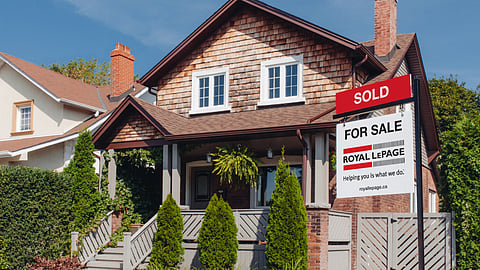


Canada’s two largest housing markets slipped into unfamiliar territory in August, with conditions favouring buyers.
On the west coast Metro Vancouver home sales reached 1,869, a 4.6% decline from August last year and 20.7% below the region's 10-year seasonal average, according to the Greater Vancouver Realtors association (GVR).
"The soft August sales data suggest the modest downward revisions we recently made to our 2026 forecast were a timely and prudent decision," said Andrew Lis, GVR's chief economist and vice-president of data analytics, attributing the decline to slowing immigration, reduced investor activity and mortgage rates that remain too high to mobilize sidelined buyers.
GVR may be in buyers’ territory, but they’ll still need deep pockets with the benchmark price in Metro Vancouver at $1,081,900 in August, down 5.6% from August last year and down 0.6% from July.
The single-family home benchmark price was $1,799,400, down 7.2% while the apartment benchmark price dropped 6.6% to $686,200, and attached properties fell back 4.4% to $1,028,800.
The number of homes listed for sale was 15,798, down 2.7% year-over-year but 26.2% above the 10-year seasonal average.
“The region's sales-to-active listings ratio settled at 12.3% in August just above the 12% floor that historical data suggests triggers sustained downward price pressure,” said Lis.
Sales also cooled in the Fraser Valley, with the Fraser Valley Real Estate Board (FVREB) reporting 941 sales, down 14% from July but up 1% from August last year.
Active listings of 9,787 homes were 33% above the 10-year seasonal average and the sales-to-active listings ratio was 10%, keeping the region in buyer's territory, said Ishaq Ismail, FVREB chair.
"We're seeing a bit of a tug-of-war between buyers and sellers right now," said Ismail. "Some buyers are seeing an opportunity to negotiate below asking price, while sellers who need to sell are more likely to accept lower offers."
Fraser Valley's benchmark price fell 0.9% in August to $869,900, a 7% annual decline, with detached homes, townhomes, and apartments each dropping between 7.1% and 8.9% year-over-year.
Buyers have been slow to react to the conditions in the GVR, said Lis.
"Ample selection, softening prices, and stable mortgage rates are considered favourable buying conditions," he said. “But they haven't been enough to bring many buyers off the sidelines.”
“While the renewed trade tensions with the USA are an unwelcome distraction for the market, we still believe the main drivers of this soft market are the slowdown in immigration to our region, reduced investor demand, and mortgage rates that aren't low enough to incentivize robust buying activity."
The Greater Toronto Area (GTA).
Sales were down in August for the first time in six months, reports the Toronto Regional Real Estate Board (TRREB) with transactions of 5,057 a 2.1% decline year-over-year and a 1.3% drop from July.
The average selling price fell 2.7% annually to $993,410, dropping below the $1-million threshold for only the second time in 2026, while the benchmark price was $931,300, a 4.5% decline year-over-year.
New listings dropped to 12,075, down 14.1% year-over-year and the drop may be doing as much to stall sales numbers as any softening in demand, said TRREB President Daniel Steinfeld, adding market conditions could shift quickly.
"If inventory tightens and home prices begin to rise, some buyers may face a trade-off between waiting for greater economic certainty and purchasing before prices move higher," said Steinfeld. "At the same time, improving market conditions for sellers could bring more listings to market, providing buyers with additional choice."
The Canada/US trade war had a negative effect on the market, said TRREB Chief Information Officer Jason Mercer.
"The main hold-back for many households has been concerns around trade with the United States and the potential for higher inflation and borrowing costs in the future," said Mercer.
The GTA has moved to being a more balanced market, said TRREB CEO John DiMichele, adding Ontario's structural supply gap remains unresolved.
"A more balanced resale market is a positive development, but it does not address Ontario's ongoing housing supply and affordability challenges," said DiMichellde. “Governments at all levels need to remove restrictive zoning policies, reduce development charges, and accelerate approvals.”
