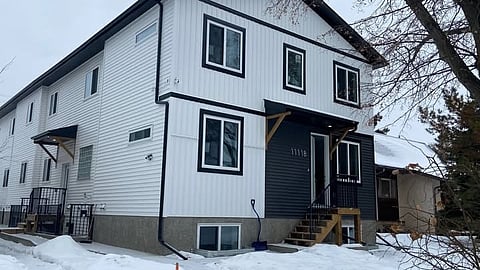


More infill housing controversies have erupted in Edmonton, centered around residential buildings that were given construction permits by the city after it changed its zoning bylaws in 2024 to allow multi-family home buildings in all areas of the city, much the same as Calgary’s blanket upzoning bylaw.
Edmonton’s bylaw is better known as the infill bylaw, which permits buildings as high as three storeys, with up to eight homes in each. Last month a group of Edmontonians spoke at a public hearing to reduce the number of units allowed to six, but Edmonton city council voted it down.
One of the buildings raising eyebrows was described in its development permit application as “a multi-family dwelling having seven or eight units”, but local resident Rhonda Bell, a resident of Edmonton’s McKernan community told Global News the building is anything but that.
“What they’re actually building is about 32 bedrooms at a time,” said Bell.
Classified posts on Facebook Marketplace and Kijiji, downloaded and supplied by residents to Global last week, but since removed, advertised daily, as well as hourly, rentals for individual bedrooms in the infill. The ads said the kitchen, bathroom, and laundry were shared areas, with no mention of living rooms. Costs ranged from $35 to $65 per night.
Bell said it is nothing short of a rooming house, more formally called a lodging house, defined by the city as ‘a building or parts of a building, containing four or more individually rented sleeping units.’
The McKernan residents sent copies of the advertisements to their city councillor, Michael Janz.
According to the city, the McKernan property in the online ad is listed as a four-plex and zoned for Small Scale Residential, but there is an application in the works to change it to a lodging house, which Janz said was “suspect.”
“Ultimately, we need more accountability around landlords,” he told Global, adding he also worries about what impact such developments have on the subject of infill, something that’s been highly controversial in Alberta’s two largest cities for years. “I think cases like this, even if they’re one or two off anecdotes, do not help.”
The lodging houses are unique developments in Edmonton, that require different safety measures. Janz said he has heard from residents with infill concerns and last year he brought forward a motion at city hall.
As a result, a coming report is expected to outline what a lodging house is, and where it can be built.
Residents say the houses have done little to add housing supply in the city and are essentially hotels in the middle of residential blocks, adding there are loopholes in existing rules being exploited the city should have caught.
“They approved the plans, knowing full well that there would be 32 bedrooms and 32 bathrooms,” said Bell, adding a city spokesperson with whom she shared the building’s plans was shocked to hear properties were being rented by the room.
“That wasn’t the plan and you can see it from the drawings of the buildings,” said Bell. “That was never the plan. Don’t pretend it was the plan. Honesty is the best policy.”
Bell said the infill next to her has been renting individual rooms monthly, which she said has created issues with parking, garbage, landscaping and snow removal.
Infill or lodging house, Bell said the actual use of the building is what matters
“When it walks like a duck and moves like a duck and quacks like a duck, at some point people have to call it a duck,” she said. “Call it what it is, then that will help the city set out appropriate bylaws for operating it, not just for building it.”
