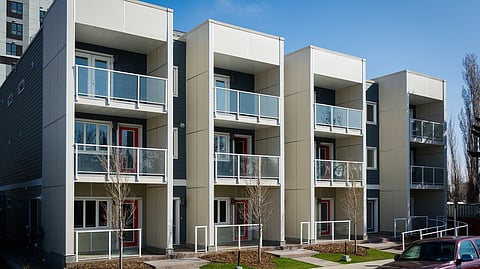


Calgarians are not the only ones dealing with an unpopular zoning bylaw; Edmontonians are fighting a bylaw approved in 2024 that allowed multi-family home buildings (infills), up to three storeys high, in neighbourhoods throughout the city.
While there isn’t a movement to repeal the bylaw in Edmonton, as there is in Calgary, Edmontonians have been vocal about the ‘infill bylaw’. voicing concerns about the size and scale of infill homes, loss of privacy, tree removal and increased pressure on infrastructure.
As a result, Edmonton City Council is reviewing proposed amendments, including restricting infill projects to a maximum of six units, particularly non-corner/mid-block sites, to address massing issues. The bylaw became a contentious issue during last fall’s elections, with residents of established communities expressing concerns about property values, lack of parking, predatory developers, quality of builds and housing affordability.
To gather feedback, the urban planning committee held a public hearing last week, giving Edmontonians the opportunity to review and speak about the amendments.
During the hearing, some of the amendments were not popular, said Edmonton Cllr. Aaron Paquette, adding there are no wrong arguments.
“Whether you’re dealing with the facts and the figures and the needs of the city or you’re dealing with the change of a neighbourhood or the feeling of not knowing what’s going to happen, those are all valid concerns,” Paquette told Global News.
Like Calgary, Edmonton has had large population growth over the last two years and also has a funding agreement with Canada Mortgage and Housing Corporation, both of which put pressures on home construction.
“So, we see this natural spike based on those artificial or unusual circumstances,” said Paquette. “When those go away, and they will, like the pressure of the population and the pressure of that grant, we get back into a normal state of development and so what happens then? And should we change policy mid-stream in an unusual time? Or do we see how it plays out over the next six months and then revisit?”
At the public hearing were members of the Residential Infill Working Group (RIWG), similar to the group in Calgary, Calgarians For Thoughtful Growth.
“It’s all about the massing,” Kathy Hawksworth, a member of the group, told Global News, adding large infills affect the privacy and sunlight of neighbouring yards, affecting plants and energy efficiency investments, like solar panels.
“The loss of gardens, the loss of solar: these have real impacts for residents that are quite apart from whether it’s six units or eight units, or in fact one unit or two,” said Hawksworth.
Another group member, Beverly Zubot, told Global adding infills needs to be done the right way.
“We need some tweaks in the zoning bylaw to make that happen.” said Zubot. “We’re hoping we can sit down with city administration and the development industry, builders, to come up with those metrics.”
RIWG suggested aligning infill front setbacks with existing homes and separating backyard suites from a main home with a yard as well as reducing the number of units per lot.
“The best format is to have four units in the front and two in the rear, and I guess that’s why we’re really encouraging the six-unit cap because that creates the building pattern that now exists in our lovely mature neighbourhoods with trees, with large enough space in between the rear building and the front building for landscaping, amenity areas, gardening, et cetera,” said Zubot.
Others at the hearing said to leave the zoning rules as they are, saying they have added housing supply to the city and have lowered rents.
The urban planning committee voted to send its findings to Edmonton City Council on Feb. 17, when another public debate is scheduled.
