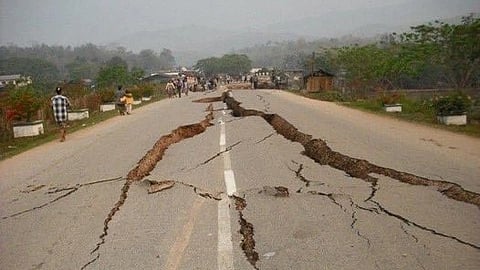
The federal government is planning a fully automated earthquake warning system designed to alert the public and take immediate protective actions, including slowing trains, diverting aircraft, and shutting off natural gas mains, according to a proposal by the Department of Natural Resources Canada. Blacklocks's Reporter says no budget or timeline has been disclosed for the expansion.“The system provides seconds to tens-of-seconds of warning prior to strong shaking from a major earthquake,” the department said in a notice to potential technical partners. The initiative would authorize private and public partners to develop and operate early-warning technologies across Canada.In 2025, the department completed a network of seismic sensors in British Columbia, eastern Ontario, and Québec’s St. Lawrence River Valley. The new proposal would allow the system to trigger automatic protective measures such as pausing industrial processes, opening doors, moving elevators to the nearest floor, and alerting personnel to drop, cover and hold. Other examples included diverting aircraft from landing, stopping trains, turning off gas supplies, opening garage doors to prevent jamming, and warning drivers approaching bridges or tunnels.Despite living near major fault zones, few Canadians are aware of earthquake risks, according to 2025 research by the Department of Public Safety Canada. Only 32% said they knew whether or how much their property is at risk, with awareness higher in British Columbia at 42% and lower in Québec at 22%. Among respondents, 32% said they had not taken protective measures because they had never experienced an earthquake, while others cited cost, disbelief, or reliance on government assistance..Earthquakes are rare but historically significant in Canada. The B.C. coast last experienced a magnitude 9 event in 1700. Anchorage, Alaska’s 9.2-magnitude quake in 1964 triggered a tsunami that caused property damage from Port Alberni, B.C. to California. Québec’s Charlevoix region endured destructive quakes in 1791, 1870, and 1925, and Canada’s last deadly tsunami from an earthquake struck Newfoundland and Labrador in 1929, killing 28. Lesser quakes have caused additional deaths in Vancouver Island in 1946 and L’Île aux Lièvres, Que., in 1925.Canada’s worst natural disaster predates modern records: a volcanic eruption around 1775 in B.C.’s Nass River Valley destroyed two Nisga’a villages and claimed an estimated 2,000 lives.