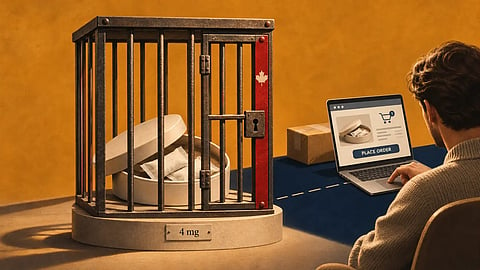


A new international report on illicit nicotine pouches singles out Canada as a country whose rules are so tight they amount to a de facto ban — while Ottawa insists its pharmacy-only regime has nothing to do with the black market.
The Global Illicit Nicotine Pouch Report 2026, released October 26 by British firm Tamarind Intelligence and commissioned by British American Tobacco, said "in Canada and Latvia, the nicotine cap is so low as to effectively ban the product category, as very few consumers would use nicotine pouches at such a nicotine level."
Health Canada caps authorized pouches at 4 mg of nicotine. A January 14 department notice said a stronger pouch "would be considered a prescription drug," and companies wanting to sell even low-dose pouches must file a product licence application with its Natural and Non-prescription Health Products Directorate.
The report found "excessively tight regulation can encourage the development of an illicit market." In 2025, 90% of pouch-related web traffic in Germany, where the category is effectively banned, and 94% in Finland, which bans online sales, went to foreign websites, compared with 10% in Sweden. In Norway, 68% of surveyed users already used pouches stronger than a proposed limit.
The authors cautioned that a single "illicit market" is "extremely difficult to measure and can also be highly misleading." They also cited "a growing body of scientific evidence demonstrating nicotine pouches to be significantly less harmful compared to combustible tobacco products."
Health Canada has denied any link between its rules and the black market.
"Current illicit sales appear to be driven primarily by unauthorized products approved as recreational items in other jurisdictions and by illegal cross-border importation," spokesperson Karine LeBlanc told the National Post in September.
That is the pattern the report describes in restrictive countries.
The Canadian Substance Use Costs and Harms project estimated tobacco use cost Canada's healthcare system $6.8 billion in 2024.
Yet Health Minister Marjorie Michel said September 22 she is not considering loosening the pharmacy-only rule, leaving one authorized brand — Imperial Tobacco's Zonnic, in mint and menthol — behind the counter.