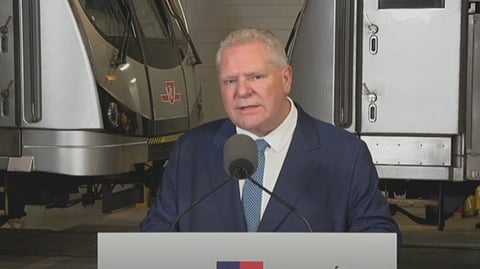
TORONTO — The Ontario government marked another milestone Tuesday in construction of the Ontario Line subway, but questions about soaring costs, lessons from past transit delays and shifting timelines quickly overshadowed the celebratory tone.At a press conference in Toronto, Premier Doug Ford and municipal and federal partners announced the start of work on an elevated guideway and four new stations in the city’s east end.The 15-kilometre Ontario Line is planned to include 15 stations and place nearly 230,000 additional residents within walking distance of transit.But as officials touted progress, reporters pressed for clarity on whether the project is repeating costly mistakes seen in previous builds — and why the price per kilometre has risen sharply compared to past subway expansions.Cost per kilometre under scrutinyOne reporter noted the Ontario Line is costing roughly three times more per kilometre than Toronto’s previous subway extension when measured in constant dollars — meaning the comparison accounts for inflation.Ford initially cited inflation and rising labour and materials costs as key drivers of higher construction expenses.“There’s a cost of inflation,” Ford said, adding the government would look for efficiencies and ensure “every single penny” is accounted for.When pressed that the comparison was already adjusted for inflation, the premier reiterated that labour and material costs have risen but did not provide a detailed breakdown of the increase.The Ontario government has committed over $70 billion to new transit projects across the Greater Toronto Area as part of a broader $223 billion infrastructure plan. The province says it is covering more than 80 per cent of the capital cost of the Ontario Line.Lessons from Crosstown delaysReporters also asked whether the Ontario Line risks experiencing delays similar to those that affected the Eglinton Crosstown LRT, which opened years later than initially projected.Metrolinx CEO Michael Lindsay said the agency has applied lessons learned from the Crosstown experience to the Ontario Line and other subway projects.“We’ve talked a lot in the last couple of weeks about the lessons that have been learned,” Lindsay said. “I can promise everybody that they’re being applied directly.”He outlined progress across the corridor, including assembly of a tunnel boring machine at Exhibition Station, excavation work at multiple downtown sites and foundational work for the elevated guideway in the east end.Lindsay emphasized that the Ontario Line contract structure was broken into multiple packages to make the project “more digestible” for private-sector partners — a change intended to reduce risk.“Thus far, the civil infrastructure work associated with this project … is on track,” he said.Timeline questionsWhile officials said construction is progressing, the expected completion window remains broad.Lindsay said civil infrastructure work is trending toward completion in the “early 2030s,” after which testing and commissioning would begin.That phase — which proved lengthy and complex for the Crosstown and Finch West LRT — involves systems integration and safety certification before passengers can board trains.“We’re trying right now to think about how we front-load systems integration considerations to reduce that testing and commissioning time,” Lindsay said.The Ontario government has not provided a specific opening year for full passenger service.The timeline language raised questions about whether the project’s operational launch could extend further into the 2030s, depending on how long the testing phase takes.Elevated guideway and new stationsTuesday’s announcement focused on construction of four stations — Don Valley, Flemingdon Park, Thorncliffe Park and Cosburn — along with a three-kilometre elevated guideway connecting them.Officials said early works are also underway at Pape Station, described as one of the most technically challenging sections of the project.Ford framed the Ontario Line as part of a broader effort to reduce gridlock and support economic growth, saying the province is using Ontario-produced materials and labour wherever possible.“We’re building the largest expansion of public transit in North America,” he said.The Ontario Line is one of several major transit projects currently underway, alongside the Scarborough Subway Extension and the Yonge North Subway Extension.As construction accelerates, scrutiny over costs, schedule and accountability is likely to continue.