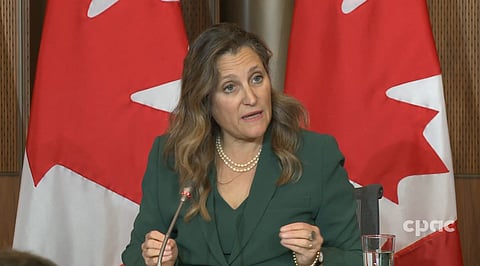
The federal Department of Finance has conceded it never conducted a cost-benefit analysis before Chrystia Freeland slapped a $389 million luxury tax on high-end vehicles, boats and aircraft — a measure that immediately hammered Canada’s pleasure boat market.Blacklock's Reporter says Gervais Coulombe, director general of sales tax policy, told the Senate national finance committee it was “very difficult” to assess the economic fallout at the time. Cabinet is now moving to repeal the tax on planes and pleasure boats, though the auto portion remains in place.Sen. Eric Forest said he raised alarms about the lack of economic vetting four years ago, when the tax was introduced. “When this measure was implemented we clearly expressed our concern about the cost-benefit aspect,” he said, asking whether an analysis had ever been done. “I doubt this has actually been done,” Coulombe replied..Freeland imposed the minimum 10% luxury tax in her 2021 budget on cars and aircraft worth more than $100,000 and on boats over $250,000. Promoting the tax at the time, she told buyers who “afford to spend $100,000 on a car or $250,000 on a boat” that they should contribute a bit more to “heal the wounds of COVID and spend in our future collective prosperity.”Coulombe testified that of the $389 million collected last year, only $26 million came from plane and boat sales — a fraction of what the government anticipated. With the aviation and recreational boat sectors struggling amid global economic uncertainty, he said cabinet opted to scrap the levy on those industries..A 2024 Inquiry Of Ministry tabled in the Commons found pleasure boat registrations fell 8% after the tax took effect. Manufacturers had warned the measure would push buyers to U.S. dealers, a trend echoed during 2022 hearings when Sara Anghel of the National Marine Manufacturers Association said luxury taxes historically drive discretionary spending out of the country.The C.D. Howe Institute later called the tax misguided. “We’ve had a few tax changes in recent years that to me seem more motivated by maybe populist objectives than economic logic,” testified former CEO William Robson in a 2024 submission to the Commons finance committee.