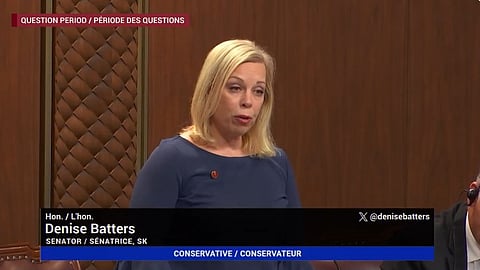
Senators are facing accusations of suppressing public opposition to a controversial Liberal-backed bill after Senate officials admitted more than 200,000 protest postcards sent by Canadians were withheld from delivery and stored in a Québec warehouse.Blacklock's Reporter says the postcards, individually signed and addressed to senators by Canadians opposing Bill C-9, were instead kept in storage in Gatineau and marked for destruction within 90 days, according to testimony heard during Senate Question Period.Sen. Denise Batters blasted the decision as “not acceptable,” accusing Senate administration of interfering with Canadians’ ability to communicate with lawmakers before a vote on the legislation.“Postcards are being held in a Senate mail room in Gatineau,” Batters said. “The Senate Property and Services Directorate had emailed senators that a ‘very large number of postcards had been received’ and that only ‘a box of postcards’ would be delivered to senators’ offices today.”Batters said her office received only 30 postcards, despite the massive volume mailed by Canadians across the country.“Each of these postcards bears a Canadian’s full name and address,” she said. “Why is the Senate Administration curtailing the right of Canadians to express their opposition to this highly controversial amended government bill to senators before we vote on it in this chamber?”Sen. Tony Loffreda, a Liberal-appointed senator from Québec and chair of the Senate budget committee, defended the decision and denied senators were attempting to silence critics.“Correspondence from Canadians is extremely important and is taken seriously,” Loffreda replied..The protest campaign targeted Bill C-9, legislation that would amend the Criminal Code to restrict public display of hate symbols including the Nazi swastika and Hamas flag, while also criminalizing intimidation and obstruction at places of worship.The legislation has also triggered concerns among religious groups over provisions dealing with opinions based on religious texts.The controversy intensified after the Bloc Québécois proposed amendments following a 2023 incident at Montréal’s Assahaba Islamic Centre, where a director publicly prayed for the destruction of Jews during a Quran reading.The House of Commons later added a clarification stating ordinary reading of religious texts would not constitute a criminal offence under the bill.Christian organizations and civil liberties advocates have since organized dozens of protest petitions warning the legislation could erode religious freedoms.Loffreda acknowledged the Senate was withholding “more than 200,000” postcards, describing the move as an efficiency measure.“To be efficient the steering committee agreed we would not distribute all the postcards to prevent disruptions and delays to regular mail services,” he said.“Each senator received sample cards addressed to them. The rest of the postcards, which have now reached more than 200,000, are being kept in our warehouse in Gatineau. Senators are welcome to visit the warehouse.”Batters questioned why senators were not being allowed to access the correspondence directly.“Why are these cards being held where they are not accessible?” she asked.“This decision was not made to silence anyone or diminish the importance of public participation in the democratic process,” Loffreda replied..Sen. Salma Ataullahjan also criticized the move, arguing senators themselves — not bureaucrats — should decide what correspondence they review.“If a concerned citizen writes to me, I think the decision should be for me to decide whether I look at that mail and what action I take,” she said.“Don’t you think this is overstepping?”Loffreda responded by noting the Senate routinely receives mass mailing campaigns.When Ataullahjan asked whether the postcards included individual names, Loffreda confirmed they did.“I think we owe it to Canadians to look at the mail they send to us,” she said.“Well, that’s a statement,” replied Loffreda. “I mean, it is 200,000.”Ataullahjan pressed further.“Would you agree?”“I always agree with the voice of Canadians,” Loffreda answered. “It is important to listen to Canadians. It is important to consider what they are saying. We’re here for the people. We represent the people.”Loffreda later said Senate administration would reconsider how the postcards are handled.Bill C-9 is currently before the Senate human rights committee.