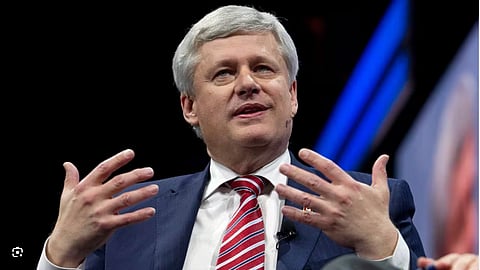
CALGARY — Stephen Harper has blasted the Alberta independence movement and its leading figures, saying there is “nothing resembling the credible leadership necessary to establish a new country.”The former Conservative prime minister laid out his case for staying in Canada in a National Post column on Friday, adding that, despite the efforts of loud factions on both sides of the argument, “most Albertans neither wish to separate nor are happy with their place in the country.”“Albertans are naturally inclined to love Canada and have made disproportionate contributions to every facet of national life,” Harper said.“They do, however, wonder why Canada periodically seems to not love them.”Harper — who served as prime minister from 2006 to 2015 — added that independence sentiment stood at a "big fat zero per cent" near the end of his tenure, because his government addressed Alberta’s problems, but has since grown out of Ottawa’s policy failures under the Liberal government.During his time in government, he removed the equalization component from federal health and social transfers at Alberta’s request, ended the Canadian Wheat Board’s marketing monopoly, changed firearms policies, appointed senators elected by Albertans, and changed regulatory processes.“Once we held a majority, our government was able to reform the regulatory process that held major resource proposals up in indefinite reviews,” he said..Stephen Harper's former comms director says independence movement leaves Smith vulnerable as Trump trade war escalates.“We created a two-year timeframe for Ottawa to give a yes or a no. Major projects, including pipelines west and east, began to move forward.”While Harper argued those measures attracted support across Canada and said a similar political coalition could be assembled again, he also sharply criticized Ottawa’s approach to Alberta’s energy sector over the past decade, calling attempts to phase out the province’s primary industry “unconscionable.”“I am unaware of a precedent like this in a democratic society. That it has spawned a separatist movement should surprise no one,” he stated.“Anyone who wishes to speak credibly for national unity in Alberta needs to recognize this.”His comments come a day after Prime Minister Mark Carney and Premier Danielle Smith announced that the Pacific Link pipeline to the BC coast will be designated a project of national interest by the federal Major Projects Office (MPO). While many energy and government figures applauded the announcement as a milestone, independence figures said the pipeline would not address fundamental issues facing Albertans..Let Alberta Decide co-leader Keith Wilson said Albertans should welcome serious attempts to export Alberta’s oil and gas, but added: “It’s Ottawa playing politics to get Albertans to forget about decades of mistreatment and how Canada does not work for Alberta.”Mitch Sylvestre, leader of the Alberta Prosperity Project (APP), also told the Western Standard on Thursday that Pacific Link would not decrease support for Alberta independence if the Pathways carbon capture and storage project is part of the overall deal, citing possible ecological issues.Despite these misgivings from independence leaders, Harper sees evidence that the current Liberal government is moving towards a more supportive approach to Alberta’s top industry and noted that Alberta could exercise more of its existing provincial authority going forward..UCP MLA confirms support for binding Alberta independence referendum.“Over a quarter century ago, I pointed out that the province had long delegated some of its own authority to the federal government,” he stated.“Having failed to exercise its own powers, it seems at best strange to be talking about full independence. At least the current Alberta government seems intent on finally addressing those matters.”Decades of debate over sovereignty in Quebec were also cited by Harper, who said using the possibility of secessionas a bargaining tool could carry lasting consequences for Albertans.“Over two generations of Quebec politics were spent debating the goal of the separatists. Families were divided, and friends were lost. The more serious the challenge became, the worse the economic impact became. In the process, Montreal’s two-centuries’ long position as the commercial centre of Canada was permanently lost to Toronto,” he stated.“I see no benefit and significant risk for Alberta to go down that path today.”