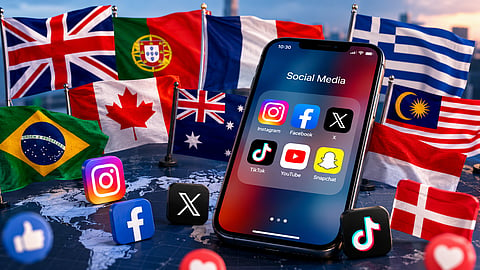


With the internet and social media having been around for a few decades now, many countries are finally attempting a ban of the latter for youth.
Among those countries is Canada, with its recent attempt to introduce Bill C-34, which would ban kids under the age of 16 from accessing social media unless the companies follow strict regulations set by the feds.
However, it is not alone on this — with bans having been implemented or considered in many countries across the globe.
With this in mind, the Western Standard has compiled a list of countries that have either already made a similar law or have it currently under consideration.
1. Australia
Similar to the proposed bill here, Australia has banned those under 16 from using platforms like TikTok, X, Facebook, Instagram, YouTube, Snapchat, and Threads.
The ban took effect in December 2025, enforced through submission of government ID, face or voice recognition, or "age inferences," which analyze online behaviour and interactions to estimate an individual's age, as reported by the BBC.
If the age restriction is violated, children and or their parents do not face penalties; instead, the platform itself does, being fined up to $49.5 million (AUD) ($48.7 million CAD).
As for what effect the ban has had six months in, according to a report by Australia’s eSafety Commission in March, seven in 10 parents stated children who already had an account on social media still had the account after the age restrictions were introduced.
And, as the New York Times reports, teenagers have found easy ways to work around the ban — drawing mustaches on their face to pass age estimation scans, creating accounts with fake birth dates, or using parents' or siblings' accounts — with some kids even revealing their accounts had just kept working.
2. Malaysia
Another country that has banned those under 16 from accessing social media platforms which have more than 8 million users, including Facebook, Instagram, TikTok, and YouTube.
Announced in June, the country will enforce the law with an age verification system, giving users a month before enforcing the rules for users to save data off their accounts.
Companies will be the ones penalized if they fail to comply with the law, with fines up to 10 million ringgit ($3.4 million CAD).
3. Greece
Greece announced it plans to ban social media access for those under 15 in April, coming into force in January 2027.
On the government website, they state there will be an age verification tool implemented to verify people's ages.
As reported by the BBC, Greek Prime Minister Kyriakos Mitsotakis stated the ban would tackle the anxiety and sleeplessness brought on by social media young people experience due to its addictive design.
There is no mention of fines or penalties if the law is violated on the Greek government's website.
4. Brazil
Taking effect back in March, Brazil's law restricts children under 16 from using social media — but the law is a bit different than the others mentioned.
As reported by AP News, those under 16 must link their social media to a parent or guardian to ensure supervision, while prohibiting platforms from offering an infinite scroll which creates addictive behaviours.
Platforms are still required to implement age verification systems that would restrict content and protect those under 18 from accessing inappropriate or prohibited material.
Companies who do not follow the regulations will be fined up to 50 million reais ($13.6 million CAD).
5. Indonesia
Indonesia announced in March a social media ban for under 16s from access to YouTube, TikTok, Facebook, Instagram, Threads, X, Bigo Live and Roblox.
As DW reports, enforcement will happen gradually, with fines being levied on companies who do not comply with age restrictions.
6. Portugal
Portugal is passing similar legislation on the matter for those under 16, adding banning betting sites to the mix, as first announced in February.
As reported by EuroNews, the law would require children to access platforms only with the consent of a parent or guardian.
However, those under 13 would not have access to the platforms at all.
They would also implement some version of age verification.
The bill has passed its first reading and needs final approval to become law.
7. Denmark
Their proposed law would ban social media for those under 15, but has yet to become law, the Denmark government first announcing it was under consideration back in November.
According to the Associated Press, the law was set to be introduced as soon as mid-2026, though there has been no update on this date.
The Danish digital affairs minister is also set to introduce a "digital evidence" app that would feature age verification tools used to help enforce the law.
8. France
Yet another still in the proposal stage, France's law would demand all social media platforms refuse new users under 15.
Reported by Le Monde, the legislation has been passed by parliament, however, the senate only passed it under several conditions in March, delaying it from being adopted.
The senate wishes to distinguish between what they deem as platforms harmful to a child's "physical, mental or moral development" and other platforms that could be accessed with parental consent.
9. UK
Also still set to be proposed in parliament, the UK bill would ban social media for those under 16.
Announced Monday, Prime Minister Keir Starmer has revealed his government will introduce the social media ban as a way to reduce young people's exposure to "dangerous content" and protect their "mental health."
The government plans to outlaw platforms ranging from Instagram, Facebook, TikTok, X, Snapchat, and YouTube for those under 16, adding it will be "looking into overnight curfews and breaks" for those under 18.
It also plans to ban AI chatbots that provide "romantic companionship," that simulate these types of intimate relationships, while only banning these types of features on general purpose AI chatbots for those under 18.
They claim they will announce enforcement measures in the coming months, along with the first set of regulations, the law will officially be enforced in spring 2027.
