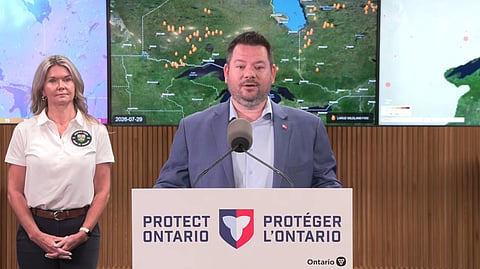


TORONTO — Ontario ministers pushed back Thursday on calls from First Nations for a public inquiry into the province’s wildfire response, saying the focus remains on putting out fires and protecting people rather than examining how the season has been handled so far.
Natural Resources Minister Mike Harris told reporters the government will conduct its usual after-action review once the fire season ends, but offered no commitment that the process would be public or independent.
“We’re very focused right now on making sure that people and property are saved,” Harris said. “Once we get through the fire season, just like we do after every fire season, we go through what’s happened… I’m not sure how the review will all work out.”
The exchange came during a joint update with Emergency Preparedness Minister Jill Dunlop and Indigenous Affairs Minister Greg Rickford as the province continues to battle 159 active wildfires.
Thirty of those remain out of control. About 2,014 people from 14 communities are still evacuated, though five communities have been able to return home.
Harris pointed to recent cooler, wetter weather and the arrival of extra crews — including more than 100 firefighters from Mexico, plus personnel from Alberta, Newfoundland, New Brunswick, the Yukon, Prince Edward Island and the federal government — as signs the situation is stabilizing. The government has invested more than $1.5 billion in wildfire operations since 2018, he said.
But reporters pressed on the gap between the official message and the experience of evacuated First Nations communities, some of whom have been sent as far as Niagara Falls and the Toronto area. Critics have described poor communication, rushed self-evacuations and inadequate supports.
Dunlop said her ministry has held more than 100 coordination calls since mid-July and continues to take feedback from chiefs. She acknowledged one chief raised ideas about training community members to help at evacuation sites, but offered few specifics on broader changes.
When asked about a staffer who cut short a media interview last week after pointed questions about First Nations communication, Dunlop called the incident “unfortunate” and an internal HR matter.
Rickford, speaking from Northwestern Ontario, emphasized ongoing private discussions with First Nations leaders and the difficulty of predicting how displaced people will respond. He rejected framing the response as simply “good or bad,” describing it instead as a constantly evolving situation.
Harris also defended the decision to bring in outside help, including Mexican crews, calling the season “unprecedented” and noting that mutual aid between jurisdictions is common. The ministry’s base budget has roughly doubled since 2018, he said, though the province still relies on contract crews and seasonal workers.
First Nations leaders have argued that an after-action review and a public inquiry can run in parallel. The ministers made clear that transparency decisions will wait until the fires are under control.
You can watch the full Press Conference below
