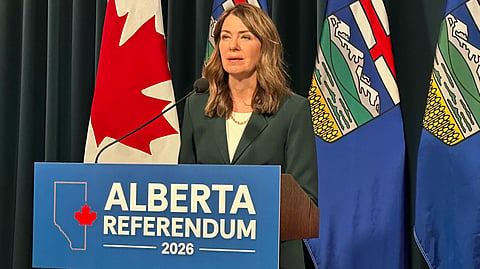


Premier Danielle Smith is entitled to oppose Alberta independence. She is entitled to argue that independence would be complicated, risky, disruptive, and politically difficult. But the claim that independence would require upwards of $400 billion in “infrastructure” costs is not a serious estimate of what it would take to make Alberta function as an independent country. It is a political number, not an operational one.
That distinction matters. Quoting a $400 billion cost is political theatre.
I am no accountant, but even I can see that three very different categories are being blurred together. The first is the cost of building or expanding the missing machinery of an independent state, including border administration, customs, passports, diplomacy, national defence capacity, expanded tax administration, federal courts, and a replacement for federal policing functions.
The second is the annual cost of programs now delivered or financed by Ottawa, including defence, indigenous services, employment insurance, pensions, federal health responsibilities, and other transfers.
The third is the balance sheet negotiation with Canada, including Alberta’s share of federal debt, federal assets located in Alberta, pension assets, federal buildings, military assets, tax room, and ongoing liabilities.
Only the first category is true startup infrastructure. The second is annual program spending. The third is a negotiated asset-and-liability settlement. To roll all three together and call it a $400 billion cost to “set up Alberta” is very misleading. It is designed to generate noise and misinformation.
The realistic question is not whether Alberta can afford to build a country from nothing. Alberta is not starting from nothing. Alberta already operates a mature Westminster parliamentary system. It has a legislature, cabinet, courts, ministries, public agencies, regulators, police contracts, prosecutors, jails, hospitals, schools, universities, land titles, energy regulators, transportation systems, corporate tax collection, and a professional civil service.
Independence would not require Alberta to invent government. It would require Alberta to assume the federal powers that Ottawa currently exercises on Alberta’s behalf.
That is not a $400 billion construction project.
A clearer estimate starts by separating true startup costs from ongoing annual operations. The core independence buildout would likely include seven practical files. A provincial police force could cost about $1 billion annually, with roughly $700 million in startup costs for recruitment, training, facilities, vehicles, communications, and equipment. A provincial revenue agency expansion could require about $1.1 billion annually and $550 million to establish the necessary tax, audit, and compliance systems. Border and customs administration might cost around $700 million annually and $350 million to build out. Citizenship and passport services could run about $350 million annually, with a $180 million startup cost, partly offset by user fees. A small national guard or defence reserve model might require $2 billion annually and about $1 billion in initial training, equipment, and facilities. Trade and diplomatic representation could cost about $150 million annually and $250 million to establish. Central administrative systems, national registries, legal transition work, and federal program integration might add another $2 billion in one-time costs and $450 million annually.
That produces a practical working estimate of roughly $7.1 billion in startup costs and about $3.68 billion in annual recurring costs for the core machinery of independence.
Even if one doubled that for contingencies, delays, inefficiencies, and the government’s usual habit of making everything more expensive than promised, one still does not arrive anywhere close to $400 billion. One arrives at a difficult but manageable transition cost.
A broader estimate, including full replacement of federal services, is obviously higher. Defence, diplomacy, pensions, employment insurance, indigenous services, federal health programs, courts, border administration, and additional policing could plausibly require between $22 billion and $32 billion annually. The Alberta Prosperity Project fiscal plan uses a similarly broad approach, estimating federal service replacement costs in that general range and identifying substantial federal revenues that would remain in Alberta.
That is not pocket change. It must be acknowledged honestly. But it is also not a new burden falling on Alberta from the sky. Albertans already pay for those federal services through federal taxes, premiums, and contributions. The independence argument is that those dollars would remain in Alberta and be redirected through Alberta’s institutions.
That is the core fact missing from the Premier’s framing. The cost side cannot be discussed honestly without the revenue side.
Conservative estimates suggest Albertans send roughly $70 billion to $86 billion annually to Ottawa in federal taxes, premiums, and contributions. Other estimates are higher. A portion returns through transfers, services, and federal operations, but Alberta has long been a net contributor.
If Alberta became independent, the relevant fiscal question would not be, “How much do these services cost?” The proper question would be: “How much of the federal revenue now collected from Albertans would remain in Alberta, and would it be sufficient to replace the federal services Alberta actually needs?”
Neither government publishes this data, so we all have to rely on estimates. On the available estimates, the answer is clearly yes.
That does not mean independence would be free. It does not mean every number produced by independence advocates should be accepted uncritically. Some estimates are optimistic. Some assume smooth negotiations. Some understate the complexity of indigenous agreements, federal asset transfers, pension administration, trade access, and currency arrangements. Those are real files. Serious people should not wave them away. But neither should government inflate them into a frightening headline number that collapses separate accounting categories into one giant political weapon.
The $400 billion claim appears to rely on a category error. If it includes Alberta’s notional share of Canada’s federal debt, that is not an infrastructure cost. It is a negotiated liability that would have to be matched against Alberta’s share of federal assets, federal tax room, federal lands, federal buildings, military assets, pension assets, and future revenue capacity.
If it includes CPP or pension assets, that is even more misleading. Pension assets are not money Alberta must spend to become independent. They are assets belonging to contributors and beneficiaries, and any Alberta Pension Plan would involve a negotiated transfer, not a cheque written by Alberta taxpayers to build “infrastructure.”
If it includes decades of program spending, that is also misleading. Annual spending is not a startup cost. It is the normal cost of running a government, paid from annual revenue.
A practical transition would proceed in stages. First, Alberta would pass a Continuity of Laws Act, so existing federal laws would continue temporarily as Alberta law. The Criminal Code, immigration rules, transportation law, commercial rules, and financial regulations would remain in effect until amended or replaced. Courts would operate. Contracts would remain valid. Police would enforce the law. Hospitals would open. Schools would teach. The point is continuity first, reform second.
Second, Alberta would create a transition treasury board to identify which federal functions must be assumed immediately, which can be handled through interim agreements with Canada, and which can be phased in over five to seven years. Border systems, customs technology, passport issuance, revenue collection, defence planning, and diplomatic offices do not all need to be built on the same day.
Third, Alberta should negotiate service-continuity agreements with Canada and the United States. Trade, pipelines, aviation, rail, trucking, banking, pensions, and border movement are too important to be disrupted for political theatre. Alberta’s oil, gas, agriculture, petrochemicals, and electricity matter to North American supply chains. Everyone involved has an interest in continuity.
Fourth, Alberta should budget honestly: a contingency-backed startup envelope of $5 billion to $10 billion over several years, plus a full federal-service replacement budget in the $25 billion to $35 billion annual range, offset by retained federal revenues. That is the grown-up number. It is serious, defensible, and understandable.
Premier Smith may believe Alberta is better inside Canada. But she should make that argument on political, constitutional, and cultural grounds, not by promoting a $400 billion figure that confuses debt allocation, pension assets, annual program spending, and actual startup costs.
The real independence infrastructure question is not whether Alberta can afford to function. Alberta already functions. The question is whether Albertans believe in themselves enough to manage the federal side of their own affairs as competently, or more competently, than Ottawa has managed them on our behalf.
That is a fair debate. The $400 billion scare number is not.
