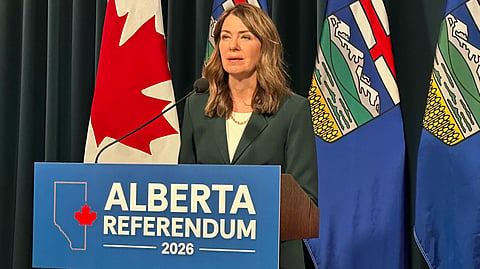
Most Albertans are too busy working, paying the bills, driving kids to practice, and discovering that an ordinary trip to the grocery store can now resemble a major capital expense. They do not spend their evenings reading court judgments or federal transfer tables. They have good reason not to follow every quarrel between Edmonton and Ottawa. But Question 10 on the October 19 Provincial referendum deserves their attention.Albertans will be asked whether we should remain a province of Canada or whether the provincial government should begin the legal process required to hold a binding referendum on separation. The question is non-binding, and the ballot offers two choices. Option 1 supports remaining a province. Option 2 directs the government to begin the legal process toward a later referendum.For undecided Albertans, Option 2 is the practical choice. This essay explains why.It does not force Alberta to leave Canada. It does not settle questions about currency, pensions, trade, debt, borders, or citizenship. It only authorizes the provincial government to start developing those answers and prepare for a direct vote. That makes Option 2 much less dangerous than its opponents suggest. It also makes it much more useful than another round of strongly worded letters that Ottawa can safely ignore.The independence question did not appear from nowhere. On July 24, Elections Alberta confirmed that a citizen initiative petition on Alberta independence had succeeded. The verified count was 222,597 signatures, well above the required 177,732. The political message is difficult to miss: a substantial number of Albertans want this question settled democratically..We should also be precise about what happens next.The October vote alone will not force Ottawa into formal secession negotiations. A later referendum would have to be held to ask Albertans directly whether Alberta should become an independent country.If a clear majority answered a clear question in favour of independence, the Supreme Court’s Secession Reference says that result would carry democratic legitimacy and create an obligation for governments to negotiate in “good faith.”But Option 2 begins the process that could eventually bring Ottawa to the table. That is its value.Ottawa has little reason to renegotiate an arrangement that works well for Ottawa. Alberta remains a major contributor to federal finances. The latest Library of Parliament analysis identifies Alberta as the largest net contributor per person, meaning the federal government collects more revenue from Albertans than it spends in the province. This point is often described badly. Alberta does not write an annual equalization cheque to Quebec. Equalization is financed from federal general revenues collected across Canada.But the imbalance is still very real..For 2026–27, with a population of 5 million, Alberta is scheduled to receive approximately $9.2 billion in major federal transfers, almost entirely through health and social transfers. Alberta will receive no equalization payment. Quebec, with a population of 9 million, is scheduled to receive approximately $30.3 billion in major transfers, including $13.9 billion in equalization. Quebec has a larger population, but the data clearly shows just how inequitable the federal redistribution of revenue between provinces really is.Helping other Canadians is not the problem. Albertans have done that for generations, usually without complaint. The problem is a federal government that depends on Alberta’s prosperity while retaining broad power over the province’s economic choices.Ottawa’s debt is another reason Albertans should demand a full accounting. The federal government projects its debt will reach $1.399 trillion by March 31, 2027, with public debt charges of $58.7 billion that year — about $161 million every day and roughly 11 cents of every federal revenue dollar. This is more than Canada spends on healthcare. And the deficits are projected to grow each year. Albertans help pay that interest through their federal taxes, yet none of it repairs a road, treats a patient, or builds a pipeline..Think about that $161 million going to bondholders every single day the next time you are stuck in traffic on the QE II.The consumer carbon tax is gone, but industrial carbon-pricing systems must still meet federal standards. Alberta may design its own system, but Ottawa determines whether it meets the national benchmark.The federal Oil Tanker Moratorium Act also prevents large tankers carrying crude oil or persistent oil products from loading or unloading along much of British Columbia’s northern coast. Whatever one thinks of the environmental justification, the law restricts one potential route for exporting Alberta energy to overseas markets..Ottawa encourages Alberta to find new customers while limiting one of the main export doors. Apparently, diversification is strongly supported provided nothing needs to be built.Alberta’s population has also outgrown its influence in Ottawa. The province now has about 12.2% of Canada’s population but only 37 of 343 seats in the House of Commons, or 10.8%, and just six of the Senate’s 105 seats. Alberta is currently represented on the Supreme Court by Justice Mary Moreau, but it has no guaranteed seat; Quebec is guaranteed three of the Court’s nine positions. Alberta is not voiceless, but in every federal institution that matters, its influence can be, and often is, outnumbered.Albertans have tried less confrontational methods for change.In 2021, 61.7% of participating voters supported removing equalization from the Constitution. That was completely ignored. Nothing changed, partly because Alberta cannot amend the Constitution by itself. The result still demonstrated that a large majority wanted the fiscal arrangement reconsidered.Ottawa had no incentive to respond. It offered no major equalization reform, and Alberta gained no lasting leverage from the exercise..That is the lesson undecided voters should remember. Political relationships change when the cost of refusing change becomes greater than the comfort of maintaining the status quo.There are serious risks in pursuing independence. A responsible Alberta government would have to publish credible plans covering currency, pensions, trade, federal debt, citizenship, and market access. Indigenous governments and treaty nations would have to be involved directly. Any proposed settlement should be independently costed, publicly debated, and approved by Albertans before separation occurred. The Alberta Transition Council is already working on those issues and is expected to publish an in-depth report by mid-August.Voting for Option 2 does not require anyone to approve an unknown final agreement. It requires the government to do the work, disclose the facts, and eventually return to Albertans with a direct question.Option 1 will be interpreted by Ottawa as approval of the present relationship. Federal politicians would learn that Alberta’s frustration has limits and carries few consequences. We would return to consultations, court challenges, and strongly worded letters, methods that we have tried for decades.Option 2 keeps Alberta’s choices open. It creates a mandate to pursue the legal process, develop the terms, and move toward the referendum that Ottawa cannot ignore.Undecided Albertans do not have to become lifelong independence supporters. They need only understand that Ottawa will not negotiate seriously until Alberta gives it a reason to do so. It will not put Ottawa at the negotiating table the next morning. But it does start the only credible process that will eventually get them there.On October 19, mark Option 2.