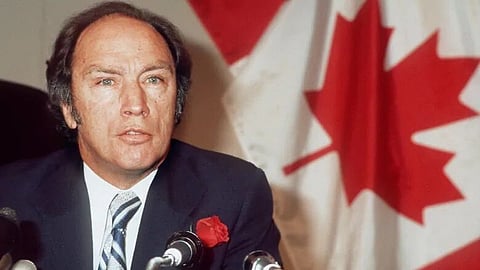
Canada faced a fork in the road in the 1980 federal election: stick with the centrist Progressive Conservative government of Joe Clark, or turn hard left with the Pierre Trudeau Liberals. Canada — or more accurately, Eastern Canada — chose Trudeau. The die was cast, and Canada would never be the same. In his final four years in office, Trudeau would fundamentally transform Canada, and not in a good way. It’s like the country fell off a cliff, politically speaking.Trudeau had governed as prime minister from 1968 until 1979 when he lost a close election to Joe Clark. During his first 11 years, Trudeau had shifted Canada in a socialistic direction — e.g., the creation of a state oil company, Petro-Canada, to extend federal government control over the oil industry — but despite his harmful policies, the country could still pull back from the brink. There was yet hope for Canada..WIECHNIK: Oil and gas still 'run the world', someone should tell Mark Carney.But with the fall of Clark’s minority government in December 1979, Trudeau had one final opportunity for power. He won the February 1980 election, and this time he decided to go for broke, remaking Canada to suit his leftist ideological blueprint.The 1980 federal election is notable for the Liberals’ deliberate effort to intensify Canada’s regional divisions in an effort to regain power. As John Duffy writes in his book Fights of Our Lives, during this election the Liberals “dropped their unity message and ran on a bald program of redistributing wealth from the West to the East.” It was in this context that Liberal campaign official Keith Davey summarized the Liberal campaign strategy as, “Screw the West. We’ll take the rest.” And they did.Upon achieving power, Trudeau introduced the National Energy Program (NEP), a raw federal power grab for Alberta’s oil resources. The NEP would devastate the province’s economy. Thousands of people lost their jobs, many lost their homes, and a large number of businesses went under. Alberta was ravaged as a deliberate result of Liberal government policy..Alberta was attacked by the federal government like no other province in Canada’s history, before or since. Trudeau wanted to centralize political and economic power in Ottawa. As Alberta Premier Peter Lougheed put it, the Liberals “really want a unitary state where any decision of substance is made in Ottawa.”The NEP was a big step in that direction..VARNER: Iran is not collapsing, but it is becoming more dangerous.Another key plank in Trudeau’s centralization agenda was his so-called Charter of Rights and Freedoms. He first proposed it as justice minister in 1968 and continued to pursue it as prime minister. When he lost the 1979 election, he was nowhere near achieving his objective.However, after being reelected in February 1980, he was determined to push it through. He was aided in this goal by the Quebec independence referendum in May of that year. He told Quebecers if they voted to stay in Canada, it would not be a vote for the status quo but a vote for reforming federalism. This injected new energy and urgency into Trudeau’s quest to repatriate and change the constitution.Of course, this time Trudeau was ultimately successful. With the repatriated constitution containing a Charter of Rights, he had fundamentally transformed the constitution and therefore the country as well..As Kenneth McDonald noted in his 1995 book His Pride, Our Fall: Recovering from the Trudeau Revolution, with the adoption of the Charter of Rights, Trudeau “changed Canada’s system of government from its foundation in the evolutionary common law, in which individuals exercised their inherent freedom to abstain from doing what the law prohibited, to a system where their ‘Rights’ and ‘Freedoms’ were no longer inherent; they were written down and ‘Guaranteed’ by the state, that is, they would be vulnerable to whatever meaning the state or its courts decided to give them.”In short, as journalist Ron Graham writes in his 1986 book One-Eyed Kings: Promise and Illusion in Canadian Politics, during his final four years in government, Pierre Trudeau had “undertook the most concerted effort at nation-building since Confederation.”Indeed, Graham continues that “Trudeau’s last term can be compared to Franklin Delano Roosevelt’s impact on American government during the Depression. The crisis prompted and permitted a major shift to the left in both cases. The reforms were structural in nature and long-lasting in effect.”.OLDCORN: ‘Singh Hortons’ has become a national disgrace, no longer ‘Canada’s coffee shop’.Although Pierre Trudeau damaged Canada considerably with his leftist policies during the 1970s, it wasn’t until his final term (1980-1984) that he was able to fundamentally transform the country. With his 1982 constitutional changes, Trudeau essentially revolutionized Canada. If he had lost the 1980 election, this would not have happened.The Liberal election victory of 1980 was a fatal turn that sealed Canada’s fate. Once a great country, it was radically altered by Pierre Trudeau into a different kind of country. There was no going back.But there is one way forward — Alberta independence. An independent Alberta would write its own constitution and create a new country focused on freedom. Since Pierre Trudeau ruined Canada, the best option is for Alberta to get out and start over.