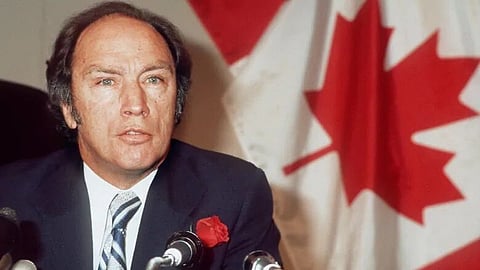
Currently, there is growing support for independence from Canada in two provinces, Alberta and Quebec. In Alberta, for the first time in history, an independence referendum will be held in October. In Quebec, the Parti Québécois, a sovereigntist party, is leading in the polls.Two provinces at each end of the country — East and West — have significant numbers of citizens wanting out of Canada. Yet, Alberta and Quebec are very different in almost every way — language, culture, history, and economy. There is one factor, though, that unites the provinces in their desire for independence — the legacy of former prime minister Pierre Trudeau. Pierre Trudeau created the Alberta independence movement in the 1970s through his unprecedented attacks on this province. Then he supercharged support for independence with his sinister National Energy Program in 1980.After the Alberta independence movement faded away due to the electoral success of the Reform Party of Canada, former prime minister Justin Trudeau resurrected the movement, building it to levels unforeseen in his father’s time.Less familiar to many Westerners, though, is the Quebec perspective on the poison pill Pierre Trudeau placed in his new constitution of 1982. That perspective is presented by Laval University political scientist Guy Laforest in his book, Trudeau and the End of a Canadian Dream. In Laforest’s view, Trudeau’s constitutional changes of 1982, especially the adoption of the Charter of Rights and Freedoms, ended the possibility of an accord that could keep Quebec in Canada.The “Canadian dream” in Laforest’s book title would be a country where Quebec’s role as the national state of French Canadians would be recognized while still remaining part of Canada. According to Laforest, what many Quebec nationalists really want for their province is a form of “decentralized federalism, with a new division of powers that would make it fully able to shoulder its responsibilities as the national homeland of French Canadians and the seat of their culture.”.Pierre Trudeau was dead-set against that sort of arrangement. He wanted a more homogenous type of Canada that would substantially diminish the distinct cultures and identities of the provinces and regions, including Quebec. Trudeau saw his Charter of Rights as helping to fulfill this goal.As Laforest explains, “One of the Charter’s objectives was to diminish the sense of regional and territorial ‘belonging’ experienced by” people in various parts of the country “and to promote among them an unmediated identification with the Canadian national community as a whole.”Trudeau figured he could defeat Quebec nationalism and therefore also Quebec sovereignty by getting Canadians to turn away from their regional and provincial loyalties, and instead focus their loyalty on a national institution, especially the Charter of Rights.In this sense, the Charter is “designed to create a homogenous Canadian community in which individuals and groups share the same set of fundamental values. By its very nature, the Charter is incompatible with a concept such as that of a distinct society, and with any idea of particular status for Quebec.”In other words, the Charter would create a homogenous national community and thereby smother regional identities, particularly the strong provincial identity of the Quebecois.As a result, “Trudeau’s project collides head-on with any project of a distinct national society and an autonomous political community in Quebec. In Mr. Trudeau’s view of things, there is no Quebec nation or people. There is a single, indivisible Canadian nation, and the people of Quebec are Canadian citizens who happen, more or less accidentally, to live in the territory of Quebec.”.By the same token, in Trudeau’s ideal, people living in Alberta should see themselves as Canadians who happen to live in Alberta, not as Albertans. The point is to eliminate provincial distinctiveness in favour of a national identity centred around the Charter itself.Quebec nationalists could not stomach Trudeau’s Charter. Indeed, Quebec never signed onto the 1982 constitution. For this reason, Laforest views it as illegitimate, as do many other Quebecers.In essence, Pierre Trudeau’s 1982 constitution, especially the Charter of Rights, ended the possibility of accommodation between Canada and Quebec. Therefore, if Quebec truly wants to defend its unique identity, it must become its own country. This is the inevitable result of Trudeau imposing his vision of Canada in 1982.In other words, Pierre Trudeau planted the seeds of Canada’s destruction. He completely changed the country with his new constitution. As Laforest aptly points out, “To change a constitution is to alter the nature, the very being, of a political body.” Therefore, it is true to say that Trudeau “is the true founder of the political system under which we have lived since 1982.”.Pierre Trudeau was not just another prime minister like the others. He is the one who founded modern Canada and established the patterns of political life that currently threaten its existence.Laforest writes that by the time Trudeau died, he “could boast about his stature as the most important political personality of twentieth-century Canada.”Indeed, Trudeau “could pride himself on having succeeded in what is, according to Machiavelli, the most difficult and perilous of political undertakings — the radical transformation of his country’s constitution. To this extent, we must see him essentially as the new founder of Canada.”Yes, Pierre Trudeau is “the new founder of Canada.” His changes to this country — especially the Charter of Rights — are the source of many significant problems. His legacy is a major factor in the current efforts of people in two provinces to leave the country. The failure of Canada can be laid at the feet of Pierre Trudeau and his vision for the country.