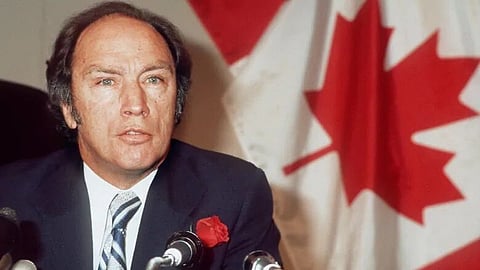
If Pierre Elliot Trudeau taught us anything, it’s that we should always be suspicious when the state suddenly becomes concerned about the protection of our rights.The latest Supreme Court of Canada (SCC) hearing over challenges to the Charter of Rights and Freedoms is no exception. Canadians should consider why the federal government’s involvement isn’t all it’s cracked up to be.From March 23-26, the SCC conducted hearings on challenges to the validity of Quebec’s Bill 21, the so-called “secularism law,” enacted in 2019. The concern is over the pre-emptive use of Section 33 of the Charter — the notwithstanding clause — to shield Bill 21 from constitutional challenges. The hearings are the biggest Charter challenge ever conducted in terms of appellants and time allowed by the SCC.Bill 21 prohibits public servants from wearing religious symbols (like hijabs, turbans, and crosses) while they’re at work, and there are numerous ongoing challenges against it. Despite upholding this law, several lower courts in Quebec have noted it’s in direct conflict with an individual’s Charter rights for equality and freedom of religion. Litigants challenging the constitutionality of Bill 21 at the SCC hearing include the English Montreal School Board, the Canadian Civil Liberties Association, and the National Council of Canadian Muslims. The federal government has also joined the challenge to limit the use of the notwithstanding clause, along with the provinces of BC and Manitoba, revealing a split in the West along party lines..In recent years, the pre-emptive use of Section 33 has become a favoured tactic of right-leaning provincial Premiers, including Danielle Smith, Doug Ford, Scott Moe, and François Legault (right-leaning for Quebec), to protect provincial laws from being struck down for violating the Charter. This makes perfect sense if we consider that the SCC is generally left-leaning and has used its authority granted after the 1982 inception of the Charter to sometimes create law instead of simply interpreting it. They have repeatedly struck down sections of the Criminal Code, for instance. But the federal government is entirely dissatisfied with the approach of pre-emptively invoking the notwithstanding clause, and not necessarily because it cares so dearly about the rights of Canadian citizens to wear religious symbols. Instead, it’s likely because they see such a tactic as allowing too much descension among the provinces, ultimately contesting federalism. It’s all the more of a concern in the wake of Alberta’s accelerating momentum toward independence.One of the chief reasons the Charter came to be in the first place was because Pierre Elliot Trudeau had witnessed a failure in the “cooperative federalism” espoused by Lester B. Pearson. After its Quiet Revolution under Jean Lesage, the province of Quebec aggressively tried to assert itself through the courts, despite Pearson’s efforts to conciliate. This continued under PET in cases like Quebec v. Blaikie (1979), trying to make French the sole language of the legislature and the courts. That was struck down as unconstitutional. But the 1982 arrival of the Charter made this type of movement toward Quebec and French sovereignty much more difficult.Albertans take note.There are echoes of Pierre Trudeau’s strategy to use the Charter to reassert federalism today..Carney’s government is arguing that the best course of action for provincial laws like Quebec’s Bill 21 is not to preemptively invoke the notwithstanding clause to shield it, but to simply allow any challenges to run through the courts first, thus exhausting alternatives. In fact, the federal Liberals feel so strongly about this that they’re considering making a limitation on the notwithstanding clause a part of the Charter. The federal government possesses a limited amount of power to make certain amendments to the Charter unilaterally, without having to first satisfy the bizarre and near impossible 7/50 amendment formula. But, despite this being the letter of the law, such a unilateral decision certainly isn’t in the spirit of the Charter, which historically follows the convention to consult all the provinces before making any changes. Out of frustration, some members of the government will be discussing the use of “disallowance,” a federal power that hasn’t been used since 1943, to override the Constitution. Pundits note that attempts to limit the use of section 33 or override it, as “disallowance” does, are likely to create serious backlash from the provinces. That would not support federalism at all.The Carney government has a balancing act before it, one where its involvement largely stems from self-interest over any purported altruistic concern for Canadians. They will likely continue to frame the issue as a protection of the rights of the individual, in the same way Pierre Trudeau did when he first dangled the carrot of enshrining individual rights into a Charter.The problem is, of course, that it was something of a bait and switch. As we approach the carrot to claim our rights as Canadians, we inevitably see it retract and be replaced with a federalist club, which will smack down any regional individualism within the provinces. Put your helmets on.