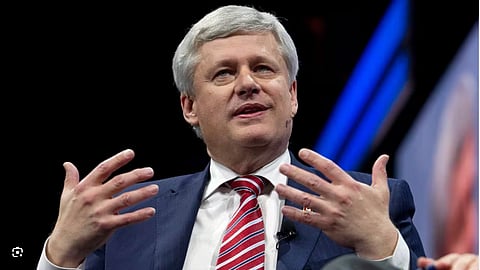
Canada’s legacy media is suddenly conducting an about-face and platforming former Conservative PM Stephen Harper. They’re happily touting words from Harper’s speech on February 3, which ended with a call for both major parties to unify in the face of existential threats — the US and independence movements. The CBC’s John Paul Tasker put it this way: “Harper said while the two major parties may differ on some matters of policy, those issues should be secondary to keeping the country together.”“He was in front of a very friendly audience,” Tom Mulcair remarked on CTV News, “but his words were very wise.”When both CTV and CBC are pimping the words of a former Conservative PM, you can be sure one of two things is happening. If it’s not the end of days, Harper must have said something that (either directly or indirectly) supports Canada’s legacy media and its benefactors.“But there’s a third option,” I hear some protest. “Canada’s legacy media is coming together for the good of the country!”I want to believe that. I really do.The trouble with such optimism is, as ever, that what benefits one demographic of such a vast, economically, religiously, and ethnically diverse nation as Canada rarely benefits another. It’s an inherent challenge for a nation that, under a radical Liberal government, endured the subversion of Canadian nationalism, values, and culture for nearly a decade. .During the Trudeau era, Canada was pulled apart under the mantra of “diversity is our strength.”Now that the challenges to Canada’s sovereignty from independence movements and the US are becoming clearer, legacy media have largely abandoned Trudeau’s utter stupidity, including his interpretation of Canada as “the first post-national state” with “no core identity.” Now they’re desperate to platform conservative ideas like nationalism.I have a notion. If the Americans really did come in and take over Canada — in any tangible sense — it’s likely not the average Canadian who’d be greatly displaced. Everyday Canadians aren’t doing that well these days, so they have much less to lose.Instead, it would disproportionately be those Canadians within the well-established avenues of power, fame, and privilege affected the most, encountering the biggest changes in lifestyle.Those families which have lived off the fattened calf of Canada’s riches would have to give up their livelihoods. The dairy cartel would fall. Canada’s subsidized state media would collapse. Many lobbyists, lawyers, and bureaucrats would suddenly find themselves unqualified under a new legal and political system. Laurentian elites like the Trudeau family would lose their power, land, and money. Above all else, the Canadian government as we know it would be permanently dissolved.This fear is certainly a contributing factor to why the media, elites, and the political class appear so obsessed with threats to Canada’s sovereignty. Wouldn’t you feel the same if you had so much to lose?That brings us back to Stephen Harper.Harper offered a few words in his speech to bring the country together. He echoed the chorus of federalist voices, which includes former prime minister Jean Chrétien, Jason Kenney, Elizabeth May, and Pierre Poilievre. Harper’s call for national unity has a high pedigree, particularly because independence movements during his tenure were at or near all-time lows..But there are things that Harper did which contributed to the current existential crisis Canada now faces. Things that are eerily similar to what Prime Minister Mark Carney is doing in office. These are decision-making processes that lead to functional problems within democracies and affect everyday Canadians disproportionately.One of the most irksome of these is the “cone of silence” Harper used more than any other prime minister. Instead of allowing the rigorous debate of bills in Parliament, Harper used a motion for time allocation (created by Pierre Trudeau in 1969, to curtail parliamentary debate) a record 92 times from 2011-2015. This set a terrible precedent, implying that majority governments need not hear excessive criticism by elected officials from opposition parties. It was technocratic in nature, not democratic.A search of Hansard (parliamentary transcripts) online reveals Carney has not yet used motions for the allocation of time anywhere near the extent Harper did. However, Carney did expedite Bill C-5, The One Canadian Economy Act, with such a motion, to ensure it was rammed through with minimal debate. Bill C-5 in itself is meant to circumvent debate, which may cause unforeseen problems.Harper’s curtailing of debate angered many left-leaning Canadians and helped facilitate Justin Trudeau's defeat of him in 2015. When in a minority government, Harper accepted floor-crossers David Emerson and Wajid Khan, moves which were and still are undemocratic. These agreements set a terrible precedent and helped to undermine the electoral process. It was not sufficient or fair, as Harper suggested, that constituents could only respond come the next election.Carney has also conducted this sort of chicanery, welcoming floor-crossers Chris d'Entremont and Michael Ma, as well as poaching an already elected Ontario MPP, NDP deputy leader Doly Begum, to run for a seat vacated from the resignation of Bill Blair. This political version of musical chairs is not democratic; it’s conducted behind the scenes and is a hallmark of technocratic regimes.The message in all this is not that Harper shouldn’t call for national unity, or that his voice added to that cause is entirely misplaced. Rather, a prime minister of any stripe who wants to claim that Canada should stick together in times of trouble must demonstrate the highest degree of responsibility, accountability, and transparency to Canadians to be taken seriously. Harper did an excellent job, I believe — especially economically — but his habitual lack of transparency, ostensibly to equalize against long-standing left-wing bias in Canadian institutions, created an angry backlash that helped lead us into ten years of destructive radical leftist policies. Carney would do well to consider this, should he continue his time in office and focus on what he deems “pragmatic” decision-making. Otherwise, he may be continuing policy-making, which further alienates everyday Canadians from the state and further erodes national unity.