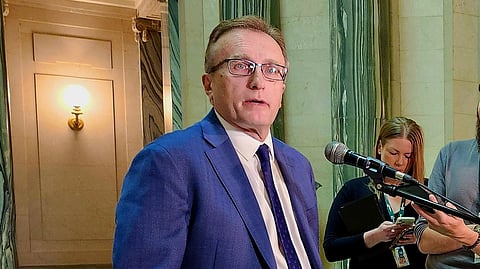
REGINA — The Saskatchewan government ended the 2025-26 fiscal year with a $947 million operating deficit, as rising healthcare, corrections, and wildfire costs pushed spending higher than expected.The year-end financial results, released on Tuesday in the province's 2025-26 Public Accounts Volume 1, showed the deficit improved from the $1.21 billion shortfall forecast in the third-quarter update.Finance Minister Jim Reiter said modestly higher oil prices helped increase revenue, but the province continued to face significant spending pressures..HARDING: Questionable answers at Regina mosque press conference were revealing enough."While we have seen a small increase in revenue from oil prices, we continue to face significant expense pressures, particularly with regard to utilization in healthcare and our correctional facilities," Reiter said.Total revenue finished $77 million above budget, while expenses rose by $1 billion to $22 billion, or 4.9% higher than forecast.The government said the spending increase was driven mainly by higher demand for healthcare services, increased wildfire response and evacuation costs, and additional spending in public safety, economic development, and education. Those increases were partially offset by lower crop insurance payouts because of improved crop yields..The province said net debt increased by $1.5 billion during the fiscal year but maintained that Saskatchewan has the second-lowest net debt-to-GDP ratio and the highest credit rating among Canadian provinces.The Sask NDP said the results showed the government had failed to accurately forecast the province's finances.Finance critic Trent Wotherspoon said the nearly $1 billion gap between the budget forecast and the final deficit demonstrated the governing Saskatchewan Party could not be trusted to manage public finances..WATCH: Regina Islamic call to prayer inspires mixed opinions.Wotherspoon also criticized the government over rising debt, saying total public debt had increased by more than $4 billion, and interest costs exceeded $1 billion. He argued the province should be in a stronger financial position to address affordability, healthcare, and education.The government has attributed much of the year's spending growth to increased demand for public services and emergency response costs, while the Sask NDP said the results reflected what it described as financial mismanagement and called for greater spending on healthcare, schools, and affordability measures.