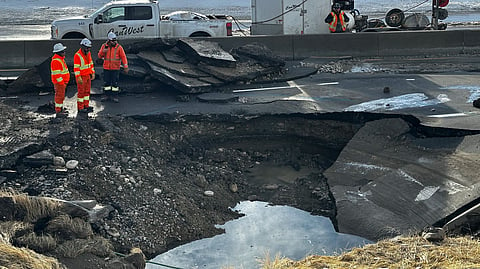


The dust has settled, or rather, the drops have dripped, on the repairs to the Bearspaw South Feeder Main rupture, the second major break in the pipe since June 2024, with no guarantees from city officials it won’t break again.
No city officials were blamed or punished for the breaks, although city council’s executive committee slapped CAO David Duckworth on the wrist after the most recent break by adding more frequent oversight meetings every year to investigate administration’s operations.
However, the Bearspaw Feeder Main Independent Review (BFMIR) report commissioned by the city to investigate the 2024 break placed the blame squarely on city administration departments going as far back as mayor Dave Bronconnier’s time in office but putting more emphasis on administrations under mayors Naheed Nenshi and Jyoti Gondek.
The report specifically cited water utility governance and oversight shortcomings as key systemic issues, and it’s clear administration is too busy to spend time checking on Calgary’s infrastructure, or doesn’t recognize a problem when they see it.
Either way, the city should immediately act on the BFMIR report’s recommendation to establish a Water Utility Oversight Board (WUOB) that would “operate independently from direct utility management and bring technical, financial, and regulatory expertise to strengthen decision-making across the water utility.”
The WUOB would operate independently from direct utility management, providing “expert advice to city council and utility leadership on system reliability, major capital investments, and risk mitigation.”
The report’s authors added independent oversight is important because Calgary’s water system is “critical infrastructure with long-term planning horizons and complex technical and financial requirements, and it can be difficult for traditional municipal structures to manage without specialized focus.”
Another very important point, if not the most important point, that supports a WUOB is that it would help depoliticize decisions that require long-range stability and expert judgment and function under a single accountable executive.
On January 8, after a unanimous vote, the council directed the administration to develop an implementation plan responding to recommendations in the BFMIR report, including governance reforms, with instructions to report back with actionable next steps.
The administration’s plan will answer whether a WUOB will be proposed; what its legal structure would be; what staffing or budget impacts it would have, and how it would interact with elected officials.
Despite the vote being unanimous, in a statement, Ward 2 Cllr. Jennifer Wyness pushed back on the proposal to form a WUOB, saying “it might remove elected officials’ oversight if not carefully structured.”
“The only new information presented (in the report) was a recommendation to carve out the water and sewer assets of the city into a separate corporation, and to remove all elected official oversight,” wrote Wyness.
“Yet the report cited multiple governance structures, all with elected officials as a comparable, including the Metro Vancouver Board consisting of 41 elected representatives. Under this proposal, the revenues and assets would transfer to the new entity, while the liabilities and overhead would remain with the city. Notably, none of the three previous reports had ever suggested this approach.”
With all due respect to Cllr. Wyness, a succession of Calgary city councils over the last two decades failed in the proper oversight of Calgary’s water infrastructure, resulting in two major pipe breaks, on the same pipe, 18 months apart.
And, there are 15 councillors and the mayor on Calgary city council, where debates can get convoluted. I can’t imagine debates with 41 voices involved.
To address Wyness’ concerns of the WUOB structure, administration is reviewing the legal framework around establishing a board and indicated that work with the panel’s chair, Siegfried Kiefer, on legal issues has occurred so that any enabling bylaw could be expedited if council directs it.
Mayor Jeromy Farkas has emphasized acting on all panel recommendations and “spare no expense” to prevent another break, framing it as a priority.
The past council’s priorities ranged from declaring a climate emergency, approving a single-use plastic bylaw, destroying established neighbourhoods with blanket upzoning, wiping historic Fort Calgary off the map, and a host of DEI and other woke nonsense, while the water infrastructure weakened and burst.
Mayor Farkas is absolutely correct; infrastructure maintenance and an independent oversight board are priorities, especially when city officials say they can’t guarantee the pipe won’t break again. They really mean, they promise it will break.
