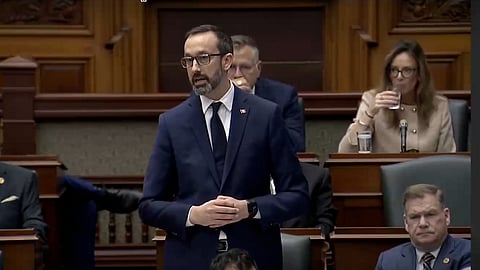


TORONTO — Colleges and Universities Minister Nolan Quinn faced questions in the legislature Wednesday over why the Canadian College of Business, Science and Technology — where the number of students receiving Ontario Student Assistance Program funding rose nearly 3,000% in three years — was not among the schools cut off earlier this year.
Data obtained by The Canadian Press through a freedom-of-information request shows the college’s four Greater Toronto Area campuses had 562 students on OSAP in 2021–22. By 2024–25 that number had reached 17,157. One campus went from 74 students to 4,481, a 5,955% increase.
Provincial grants for students at that single campus rose more than 8,000%, to $39 million. Across all four campuses the college accounted for roughly $151 million in provincial grants in 2024–25.
The growth was driven almost entirely by online programs. In 2021–22 only 6% of the college’s OSAP recipients were studying online; by 2024–25 that figure was 97%.
In May, Quinn made six other career-college campuses ineligible for OSAP over concerns about “high-risk” admissions practices. Those schools had seen OSAP growth of between roughly 650% and 1,375%.
The Canadian College of Business, Science and Technology was not on that list.
Quinn has said the initial focus was on the six campuses and that the “evolving nature of the data” meant the full scale of the problem only became clear later.
In October the government paused OSAP payments to all 242 private career colleges after a KPMG review flagged serious integrity concerns and the matter was referred to the Ontario Provincial Police.
Quinn has previously described preliminary findings that include third parties completing coursework for students, entire courses finished in a single day, final exams completed in as little as six minutes, thousands of applications submitted from the same IP addresses, and students who could not identify their school, program or courses.
He has also cited common ownership, the involvement of immigration services firms, and inadequate verification of enrolment and outcomes.
Opposition members pressed the minister Wednesday on why a school with growth rates far higher than the six that were cut off was left in the system for so long.
The government has tabled legislation that would cap OSAP-funded enrolment growth at private colleges, make predominantly online programs ineligible, and tighten verification rules.
Quinn has said he expects payments can resume by the new year if the bill passes, while the KPMG review and police investigation continue. The college has not responded to multiple requests for comment.